

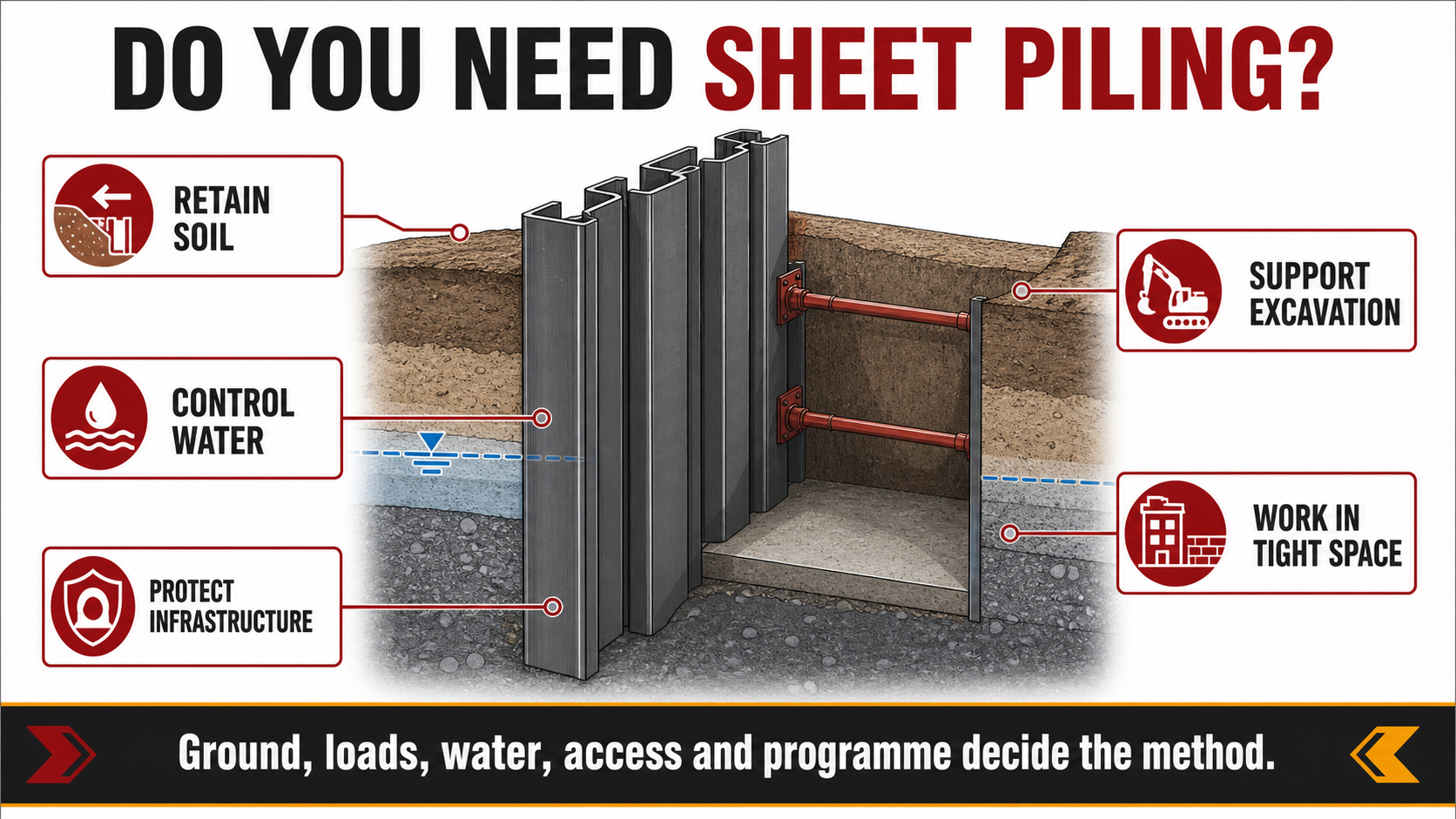
Sheet piling is not a default answer for every retaining-wall or excavation problem. It becomes worth considering when a project needs a slim, strong barrier that can retain soil, help manage groundwater or water pressure, support an excavation, or work around difficult site constraints.
The right solution still depends on the ground investigation, retained height, loading, water conditions, access and construction sequence. This guide explains the situations where sheet piling is commonly used and the questions to settle before selecting a method.
What makes sheet piling different?
Steel sheet piles are driven or pressed into the ground and connect through interlocks to form a continuous wall. That continuous form is what makes them useful where a project needs more than a simple edge restraint: for example, excavation support, a river-wall repair, a cofferdam or a flood-defence line.
For a fuller introduction to the system, see what sheet piling is and how it works. The decision to use it should then be based on the job’s actual constraints, not on a generic specification.
1. You need to retain ground beside an excavation
A deeper excavation can place adjacent soil, structures, roads or services at risk if the sides are not properly supported. A sheet pile wall can form an engineered retaining line while foundations, drainage, basements, bridge elements or other work is completed below ground level.
The HSE’s excavation guidance is clear that temporary support needs to be decided before digging starts. No ground can be assumed to remain stable in every circumstance. This is why ground conditions, surcharge loads, nearby structures and build sequence all need reviewing early.
2. Water, seepage or a dry working area is part of the problem
Interlocking piles can create a continuous wall line, which is useful around water or where seepage needs managing as part of the design. Common applications include river and canal works, outfalls, quay repairs and temporary cofferdams.
Whether a wall needs to be fully watertight, reduce seepage, or simply retain ground beside water is an important distinction. Interlock condition, sealants, pile profile, depth and the surrounding ground all affect performance. For projects that need a dry work area, SPS can provide cofferdam construction and installation.

3. Space is tight or excavation needs to stay close to the boundary
Sheet piles have a relatively slim wall form. That can make them a practical choice where the project is close to a property line, highway, railway, riverbank or existing structure and there is limited room to form a wider retaining solution.
Access still needs careful planning. Plant size, headroom, delivery routes, working-platform requirements and exclusion zones can all influence the method. Where conventional piling plant cannot operate, the project may need a Movax piling or silent piling assessment instead.
4. The wall has to protect infrastructure or an embankment
Sheet pile retaining walls are widely used around roads, railways, industrial plots and waterside infrastructure where ground needs to be retained within a controlled footprint. They may be temporary support during construction or a permanent structural element, depending on the design.
This is a design-led decision. The wall must account for soil and water pressures, any traffic or building loads behind it, drainage, corrosion allowance, connection details and the intended design life. SPS can advise on the installation approach for sheet pile retaining walls once the project information is available.
5. You need temporary works that can be extracted after construction
Many schemes use sheet piles as temporary excavation support or cofferdams, then extract them when permanent work is complete. Whether extraction is suitable depends on the system, ground, adjacent structures, programme and the potential effects of removing the piles.
Temporary does not mean lower risk. The HSE explains that temporary works must be planned and managed, and that a structure must withstand foreseeable loads. The design, checking and coordination arrangements should be agreed before installation.
When might another retaining solution be better?
Sheet piling is one option among several. A king post wall, reinforced concrete wall, secant pile wall, slope regrading or another approach may suit a project better where the loads, ground, visual finish, drainage or access point in a different direction.
The key is not to choose a system before the constraints are known. Send the available drawings, ground information, retained height, site photographs and programme to the specialist team early enough to assess the practical route.
Questions to answer before requesting a sheet piling quote
- What needs retaining, and how high is the retained ground?
- What ground and groundwater information is available?
- Is the wall temporary, permanent, or serving both purposes during the build?
- Is seepage control, a cofferdam or a dry working area required?
- What structures, utilities, railways, roads or watercourses are nearby?
- What access, headroom, noise and vibration constraints apply?
- What plant can be safely supported by the working platform?
Discuss the right approach for your project
Sheet piling is most effective when the wall system and installation method are selected around the site, rather than fitted to it afterwards. If you are at planning stage or have a live retaining, excavation, water or infrastructure problem, talk to Steel Piling Solutions about the project.
Frequently asked questions
Do I need sheet piling for a basement excavation?
It may be suitable where the excavation needs engineered support, particularly near boundaries, roads, neighbouring buildings or groundwater. The final choice depends on the ground, depth, loads, access and the temporary-works design.
Can sheet piles be used for flood defences?
Yes. Steel sheet piles are often used within flood-defence and river-wall schemes where a continuous embedded wall is required. The wall design needs to address flood level, seepage, ground conditions, corrosion and tie-ins to existing defences.
Does sheet piling always create vibration?
Installation effects depend on the selected method and site conditions. Where vibration or noise is sensitive, the project may need an alternative method such as hydraulic press-in piling. This should be assessed before the installation plan is fixed.