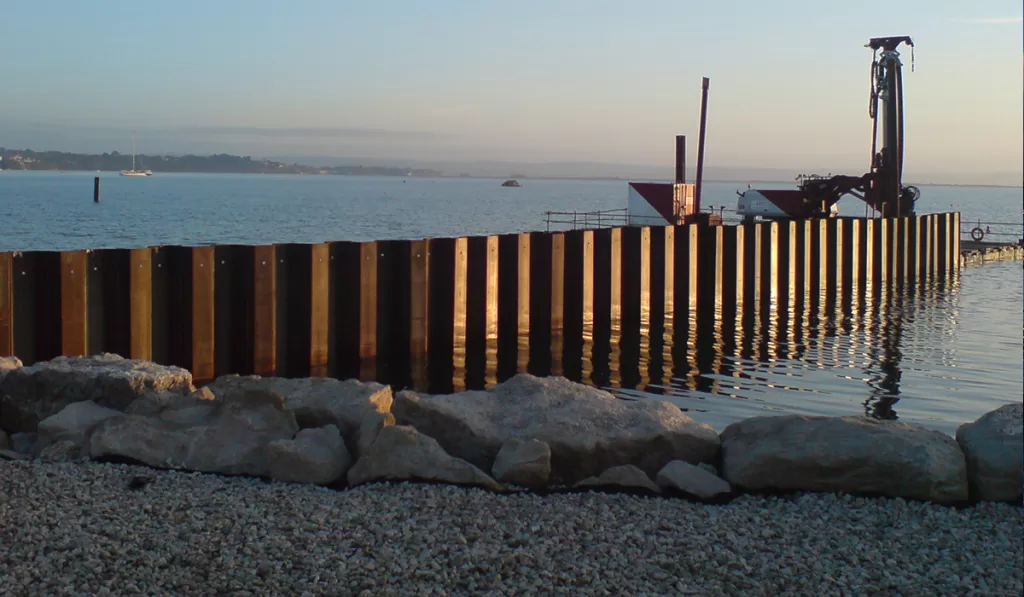
Sheet Piling UK: The Complete Guide

Sheet Piling UK Guide

Sheet piling is one of the most widely used retaining wall solutions in the UK. From flood defences and marine structures to highways and rail embankments, it provides a fast, durable and cost-effective way of supporting ground and water.

This guide has been written for construction professionals who need clear, technical insight into sheet piling – not surface-level definitions. It covers the fundamentals, design considerations, installation methods, and UK-specific applications, as well as the challenges and innovations shaping the industry.

By the end, you’ll have a complete reference on how sheet piling works in practice, the environments it suits best, and the factors that drive cost and performance on UK projects.

2. What is Sheet Piling?

Sheet piling is a method of forming a retaining wall by driving prefabricated sections (usually steel) into the ground to a required depth. The piles interlock to create a continuous wall that resists soil and water pressures, providing both temporary and permanent support. Learn in depth about what is sheet piling in one of our previous blogs.

2.1 Temporary vs Permanent Sheet Piling

  • Temporary works: Sheet piles are commonly used for cofferdams, trench support, and excavation works. Once the structure is complete, the piles can be extracted and reused. Read our temporary sheet piling guide to learn more.

  • Permanent works: In flood defence, basements, quaysides, and rail or highway embankments, sheet piles are left in place as a long-term structural element.

2.2 Advantages of Sheet Piling

  • Rapid installation compared to bored or cast-in-situ walls

  • Minimal site footprint, ideal for constrained urban or rail projects

  • Capable of high load resistance when driven to depth

  • Reusable and recyclable, reducing overall environmental impact

2.3 Alternatives to Sheet Piling

While sheet piling is versatile, it competes with other retaining systems depending on site conditions:

Retaining MethodKey AdvantagesLimitations in UK ContextTypical Use Cases
Sheet PilingFast, reusable, high strengthNoise/vibration in sensitive areasMarine, rail, flood defence
King Post WallsCost-effective, flexible designLower water cut-off, not fully continuousBasements, temporary works
Contiguous Bored PilesVibration-free, suited to urban sitesSlower, more expensive, larger footprintDeep basements, city centre projects

3. Sheet Piling Methods & Techniques

The method chosen to install sheet piles is dictated by ground conditions, environmental constraints, access, and project requirements. In the UK, the main techniques are vibratory driving, impact driving, silent pressing, and excavator-mounted systems such as Movax. Pre-augering and pre-drilling may also be used to assist installation.


Vibro Hammer Installation

3.1 Vibratory Driving

  • Overview: The most common method, using a vibro hammer to oscillate the pile vertically until it penetrates the ground to the required depth.

  • Applications: Flood defences, highways, marine works, bulk earth retention.

  • Advantages:

    • Fast installation rates

    • Suitable for long linear walls

    • Lower impact forces compared to traditional impact hammers

  • Limitations:

    • Vibration can be an issue near sensitive structures or services Less effective in dense gravels or hard strata

Hammer and crane, driving sheet piles

3.2 Impact Driving

  • Overview: Uses a hydraulic or diesel hammer to deliver repeated blows to the pile head, driving it through dense soils or obstructions.

  • Applications: When refusal is reached with vibratory driving or when piles must penetrate very stiff strata.

  • Advantages:

    • Ensures piles reach design depth even in difficult ground

    • Provides high bearing capacity for heavily loaded structures

  • Limitations:

    • Higher noise and vibration levels

    • Often requires restrictions in urban or rail environments

Silent Piler on Sheet Piles

3.3 Silent Pressing (Giken)

  • Overview: Uses hydraulic jacks to “press” piles into the ground, clamping to previously installed piles as reaction.

  • Applications: Urban and rail environments, sites with vibration or noise restrictions, sensitive heritage areas.

  • Advantages:

    • Vibration-free, extremely low noise

    • High precision in alignment and depth

    • Allows work adjacent to live railways or existing structures

  • Limitations:

    • Slower than vibratory methods

    • Requires stable reaction piles and suitable working platform
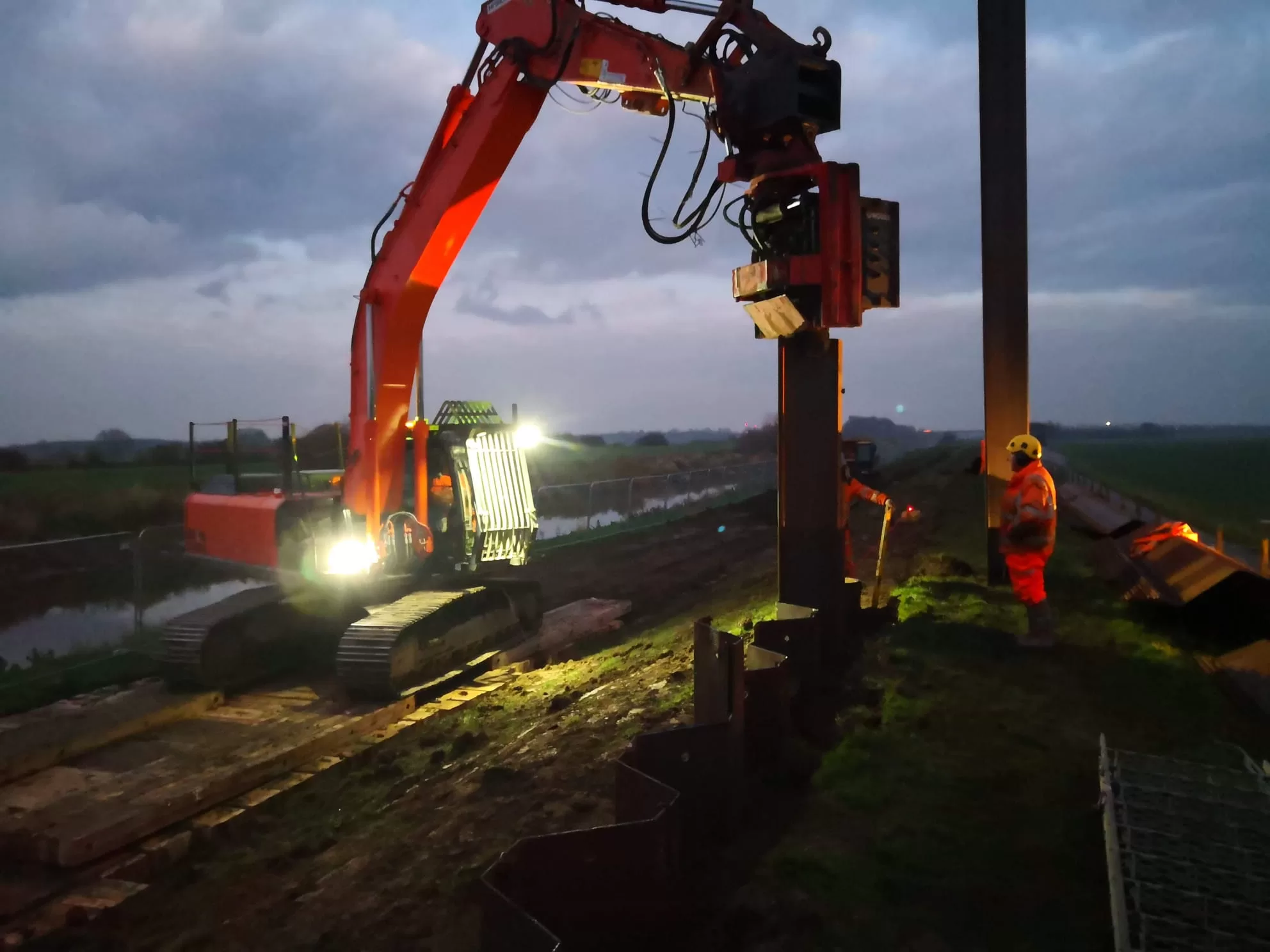

3.4 Movax / Excavator-Mounted Systems

  • Overview: Side-grip vibratory hammers mounted on an excavator, controlled with real-time instrumentation.

  • Applications: Tight-access sites, riverbanks, flood defence, highways and temporary works.

  • Benefits of Movax Piling:

    • Highly flexible, can operate in areas unsuitable for larger rigs

    • Fast mobilisation and set-up

    • Reduced plant footprint

  • Limitations:

    • Generally used for shorter wall lengths compared to full rig systems

    • Operator skill critical to achieving tolerances

Pre Augering for Sheet Piles


3.5 Pre-Auger/Pre-Drilling Assistance

  • What is Pre Augering? Drilling a pilot hole ahead of pile installation to ease penetration in dense ground or reduce vibration near sensitive assets.

  • Applications: Urban sites, rail embankments, mixed ground conditions with obstructions.

  • Advantages:

    • Prevents refusal

    • Reduces pile damage and misalignment

    • Enables vibration-free systems to operate effectively

  • Limitations:

    • Adds additional process step

    • Requires survey and strict depth control to maintain wall integrity


📊 Method Selection in the UK

MethodBest Suited ToRestrictions / Considerations
Vibratory DrivingLarge-scale flood/rail/marine worksLimited near vibration-sensitive assets
Impact DrivingDense ground, stiff clays, obstructionsNoise and vibration management essential
Silent Pressing (Giken)Urban sites, rail, heritage areasSlower, requires reaction piles
Movax (Excavator-Mounted)Restricted access, flood defence, temporary worksLimited for very long walls
Pre-Auger/Pre-DrillingObstructed ground, vibration-sensitive areasAdds cost and programme time

4. Common Applications in the UK

Sheet piling is a versatile solution across UK infrastructure. Its value lies in being fast to install, highly adaptable, and capable of handling both temporary and permanent demands.

Flood Defence and Marine Works

Coastal defence is one of the most important uses of sheet piling in the UK. Steel piles provide a watertight barrier and resist constant wave and tidal pressures. Typical applications include:

  • Quay walls, jetties and harbour structures

  • Flood embankment reinforcement

  • Riverbank and canal stabilisation

Durability is key in marine settings. Steel piles can be coated or fitted with cathodic protection to extend their service life against saltwater and abrasion.

Highways and Rail Infrastructure

On transport projects, sheet piles provide immediate retention without needing large excavation footprints. They are widely used for:

  • Embankment stabilisation

  • Road widening and cuttings

  • Rail infrastructure where possessions are limited

In rail environments, vibration-free methods such as Giken pressing are often specified to avoid disruption to live lines and adjacent assets. The speed of installation compared to bored solutions is a major advantage when programmes are tight.

Basements and Urban Excavations

In constrained city-centre projects, sheet piles are favoured over bulkier retaining options. They provide continuous support and can be combined with props, anchors or struts to accommodate deeper excavations.

  • Suitable for permanent basement walls or temporary retention

  • Occupies less site space than contiguous piles.

  • Option to extract and reuse piles for sustainability

Cofferdams and Temporary Works

Cofferdams remain one of the classic uses for sheet piles. Interlocked sections are driven to form an enclosed box or cell which can be pumped dry, creating a safe working area in waterlogged or tidal ground.

  • Bridge pier foundations

  • Culvert and outfall works

  • Marine and harbour repairs

The ability to dismantle and reuse sheet piles makes cofferdams cost-effective for contractors managing repeat temporary works.

Industrial and Energy Projects

Large industrial schemes frequently use sheet piles for retaining walls, cut-off barriers, and foundations. Power stations, chemical plants, and ports often demand rapid programmes and high reliability, making sheet piling the preferred choice.

6. Challenges and Solutions in Sheet Piling

While sheet piling offers speed and versatility, successful delivery depends on anticipating and managing common challenges. Across UK projects, the most critical issues tend to be vibration control, restricted access, working in flood defence environments, and building in urban areas.

Urban Works

Installing sheet piles in city centres often brings restrictions on noise, vibration and working hours. Sensitive assets such as heritage buildings, utilities, and transport links can’t be compromised.

  • Challenge: High risk of disturbance to surrounding structures.

  • Solution: Use silent pressing (Giken) or Movax systems to reduce impact. Pre-augering can also ease pile penetration while minimising vibration.

Flood Defence Environments

Coastal and river works demand more than structural strength – the piles must also resist constant exposure to water and tidal forces.

  • Challenge: Durability in aggressive environments and the need to work within tidal windows.

  • Solution: Use coated or cathodically protected steel, supported by robust planning for access and safety. Cofferdams are often required to create dry working areas.

Restricted Access Sites

Many UK sites, particularly in rail or highways, simply don’t have space for large rigs or multiple pieces of plant.

  • Challenge: Delivering full-scale sheet piling works where site footprint is limited.

  • Solution: Excavator-mounted Movax systems provide flexibility, allowing efficient installation without the footprint of a leader rig. Careful sequencing and plant coordination are essential.

Vibration Management

Ground vibration is often the deciding factor for whether a method is viable. Close-by rail infrastructure, live utilities and built-up areas can make standard vibro or impact driving unsuitable.

  • Challenge: Preventing damage while still achieving design depth.

  • Solution: Silent pressing techniques and pre-drilling to reduce resistance. Vibration monitoring can be built into the methodology to ensure compliance.

By understanding these challenges and applying the right method, sheet piling remains one of the most practical solutions for retaining walls and flood defence across the UK.

7. Selecting the Right Contractor in the UK

Choosing a contractor for sheet piling is about more than availability of plant. The success of a retaining wall, cofferdam or flood defence scheme depends on a team that understands ground conditions, methodology, and the site-specific risks.

A reliable contractor will:

  • Provide a clear methodology statement tailored to the site

  • Offer in-house operators with specialist tickets and decades of experience

  • Maintain a fleet that covers multiple installation methods (Movax, Giken, vibro, pre-auger)

  • Demonstrate a track record across infrastructure, marine, flood and rail projects

At Steel Piling Solutions, our expertise comes from over three decades of focused experience in sheet piling. We operate across the UK and Ireland, delivering schemes from flood embankments to rail retaining walls. Our approach is built around safety, accuracy and programme certainty, backed by a fleet of specialist rigs and excavator-mounted systems.

Whether it’s urban works, tidal defence, or restricted-access piling, SPS provides the combination of equipment and expertise to ensure projects are completed on time, on budget, and to the highest standard.

8. Conclusion

Sheet piling remains one of the most reliable and widely used retaining systems in the UK. Its speed of installation, adaptability to different ground conditions, and proven long-term performance make it essential across flood defence, marine works, transport infrastructure, and urban development.

The choice of method — whether vibro, silent pressing, Movax or pre-augering — depends on project-specific challenges, from vibration control in city centres to durability on tidal works. Success ultimately comes down to using the right approach for the environment at hand, delivered by an experienced contractor with the equipment and knowledge to execute it safely and efficiently.

At Steel Piling Solutions, we’ve built our reputation on exactly that. With decades of specialist experience and a modern fleet, we provide sheet piling services that meet the demands of UK infrastructure today while preparing for the challenges of tomorrow.

What is Pre Augering?

WhatsApp Image 2024-07-22 at 19.29.16_9a742ca0

What is Pre Augering?

Table of Contents

What is Pre-augering?

Pre-augering is a ground preparation method used in sheet piling where an auger is drilled into the soil before installing the piles. The aim is not to excavate but to loosen dense or obstructive material that would otherwise increase resistance or cause pile deflection.

In practice, this allows the piles to be driven or pressed more cleanly, avoiding excessive stresses on the pile and equipment. It’s especially useful in urban environments, railway embankments, or sites where vibration and noise must be minimised.

At Steel Piling Solutions, we often combine pre-augering with low-vibration methods such as silent pressing or Movax systems—helping us maintain accuracy and programme certainty, even in challenging ground conditions.

Pre Augering for Sheet Piles

Why Pre-augering is Used in Sheet Piling

Sheet piles are typically installed using vibro hammers, impact driving, or silent pressing. But these methods can quickly meet their match when ground conditions include:

  • Stiff or over consolidated clays

  • Dense sands, gravels, or cobbles

  • Historic fill, buried obstructions, or reinforced concrete

  • Zones with unpredictable layers and high refusal risk

Without pre-augering, these materials can prevent piles from reaching the designed depth. Worse, they can cause damage, misalignment, or lead to programme delays.

Pre-augering solves this by preparing the ground before installation. The process softens the resistance just enough to guide the pile down to depth, keeping alignment true and reducing the force required. This is essential when working near:

  • Rail assets

  • Underground services

  • Live buildings or retaining structures

  • Sensitive heritage sites

It’s also an effective support strategy for silent piling methods where brute force is not an option. By removing the toughest layers ahead of time, we make precision installation achievable—even where vibration-free requirements are in place.

How Pre-augering Works in Practice

Pre-augering is typically carried out using a piling rig or excavator fitted with an auger attachment. The auger drills boreholes to a pre-determined depth—usually just short of the final pile toe level—and follows the exact line where the sheet piles are to be installed.

There are a few approaches depending on the ground and installation method:

Continuous augering: This is carried out along the full length of the wall before any sheet piles are installed. It’s common on linear walls in uniform ground conditions or when piles must follow a strict alignment.

Targeted augering: Used when only certain sections of the line contain hard spots, buried obstructions, or high-resistance layers. This is often guided by previous ground investigations or refusal data from earlier installations.

Support augering for silent piling: When using systems like Movax or Giken, augering is often carried out at regular intervals to help overcome resistance while maintaining low vibration and noise levels.

Typically, the borehole diameter is kept slightly smaller than the sheet pile width. This ensures the pile still beds into the surrounding ground tightly, maintaining integrity and load transfer while reducing resistance.


Ground Conditions That Require Pre-augering

Pre-augering becomes essential when ground resistance poses a risk to productivity, precision, or safety. We typically recommend it on sites where:

Urban and brownfield environments
Often contain buried rubble, brickwork, and legacy foundations. Augering helps clear these obstructions while reducing the risk of pile damage or misalignment.

Railway embankments and infrastructure
Pre-augering allows us to install piles with minimal ground movement and vibration, protecting adjacent track beds, signalling, and drainage.

Mixed or granular fill
Sites made up of backfill, boulders, or coarse gravels are unpredictable and often show variable refusal depths. Augering levels the playing field and improves installation control.

Low-impact or vibration-free piling zones
Where noise, vibration, or ground disturbance must be kept to a minimum—such as near hospitals, heritage buildings, or live utilities—pre-augering supports silent piling techniques.

Restricted access or tight-tolerance environments
On sites with little room for rework or margin for error, augering helps avoid delays caused by refusal and keeps the installation programme moving forward.

Machinery and Techniques Involved

Pre-augering can be completed using a variety of equipment depending on the access and ground conditions. This includes:

  • Excavators fitted with auger drives

  • Piling rigs with interchangeable auger heads

  • Specialist rotary or CFA rigs for deeper or larger diameter bores

On many SPS projects, we use our own Movax-equipped rigs, allowing us to switch between pre-augering and vibro or silent pile installation efficiently. The auger type and depth are chosen based on site investigation data and the final pile design.


Benefits of Pre-augering for Sheet Pile Installations

✔️ Reduces resistance and ensures piles reach designed toe levels
✔️ Minimises vibration — essential near sensitive assets or infrastructure
✔️ Improves alignment by guiding the pile along a prepared vertical path
✔️ Supports low-impact methods like Giken or Movax in difficult ground
✔️ Prevents refusal, delays, and pile damage in known hard strata

By dealing with problem ground up front, pre-augering reduces the risk of issues mid-installation and helps us keep piling operations efficient and on schedule.


Common Misconceptions

“It weakens the ground too much.”
Incorrect. Boreholes are kept narrow and controlled—enough to reduce resistance, not structural integrity.

“You don’t need it with vibro rigs.”
Even high-frequency vibrators can struggle in dense or mixed strata. Pre-augering often prevents refusal and deflection.

“It slows down the programme.”
In reality, it often speeds things up by avoiding time-consuming refusals or misalignment corrections.

Is Pre-augering Right for Your Project?

Pre-augering isn’t always required—but on the right site, it can make a major difference. If your project involves hard ground, buried obstructions, or low-vibration installation methods, pre-augering can be the key to smoother progress, better pile alignment, and fewer delays.

At Steel Piling Solutions, we assess every project on its merits. When pre-augering is needed, we provide the right rigs, experienced operators, and seamless integration with silent or vibro piling systems to get the job done efficiently and safely.

A Guide to Types of Cofferdams for Contractors and Engineers

A Guide to Types of Cofferdams for Contractors and Engineers

Flood management, underwater construction, and deep excavations near water all pose the same fundamental problem: how do you keep a work area dry? Cofferdams are the answer, and sheet piling plays a central role in how many are constructed.

This guide outlines the main types of cofferdams used in UK construction, how each works, and when to use them.


Table of Contents

  1. What Is a Cofferdam?

  2. When Are Cofferdams Used?

  3. Types of Cofferdams

    • 3.1. Braced Cofferdams

    • 3.2. Cellular Cofferdams

    • 3.3. Rockfill Cofferdams

    • 3.4. Earthen Cofferdams

    • 3.5. Single-Wall and Double-Wall Cofferdams

    • 3.6. Inflatable Cofferdams

    • 3.7. Sheet Pile Cofferdams

  4. Comparing Cofferdam Types

  5. Design Considerations

  6. FAQs About Cofferdams

  7. Conclusion


1. What Is a Cofferdam?

A cofferdam is a temporary structure designed to exclude water from a particular area so that construction work can be carried out in dry conditions. Cofferdams are most commonly built using interlocking steel sheet piles that form a watertight barrier.

They are commonly used for bridge piers, flood defence work, dock and harbour upgrades, pipeline installations, and culvert construction.


2. When Are Cofferdams Used?

Cofferdams are used when:

  • A dry work environment is needed in or near water

  • Foundations, pipelines, or culverts need to be placed below the water table

  • Work is taking place in tidal or flood-prone areas

  • There is a need to isolate the excavation area from surrounding groundwater or river flow


3. Types of Cofferdams

3.1. Braced Cofferdams

Braced cofferdams are made from sheet piles driven into the ground and braced internally with waling beams and struts. These are commonly rectangular or circular and are used for deep excavations where ground pressure must be resisted.

Best for: Deep excavations with limited external access.

Sheet piles: Yes. Often primary structural element.

Example: Circular shaft excavations for pump chambers or valve pits.

Excavation inside steel cofferdam with internal framing for gas pipeline intersection works Internal braced cofferdam used to provide safe working access for gas pipeline connection project.

3.2. Cellular Cofferdams

Cellular cofferdams are large, circular or diaphragm-shaped cells formed using steel sheet piles filled with granular material. The individual cells are interconnected for stability. They rely on mass and internal friction for stability, not internal bracing.

Best for: Large marine or riverine projects.

Sheet piles: Yes. Used to form the cell walls.

Example: Harbour works or large bridge piers in tidal rivers.


3.3. Rockfill Cofferdams

These are temporary dams made by placing rockfill in a trapezoidal profile across a river or stream. An impermeable membrane may be placed on the upstream face.

Best for: Small rivers or low-head water control.

Sheet piles: No. Typically loose rock.

Example: Diversion dams for water treatment works.


3.4. Earthen Cofferdams

Constructed from compacted earth, sometimes with a clay core. These are generally used for shallow, low-risk works and may require internal drainage systems.

Best for: Shallow water and short-term works.

Sheet piles: No. Often lined with geotextile or membrane.

Example: Stream diversions or shallow channel isolations.


3.5. Single-Wall and Double-Wall Cofferdams

  • Single-wall cofferdams consist of a single row of interlocked sheet piles, typically used for small excavations or limited access.

  • Double-wall cofferdams have two parallel rows of sheet piles with granular fill in between. They provide greater stability and water-tightness.

Best for: Urban sites and culvert installations.

Sheet piles: Always.

Example: Pipeline crossings or basement waterproofing.


3.6. Inflatable Cofferdams

Made of fabric tubes filled with water or air. These temporary barriers are quick to deploy and are mainly used in shallow or low-risk water control.

Best for: Emergency works or short-term flood isolation.

Sheet piles: No.

Example: Stream crossings or protection during minor road culvert upgrades.


3.7. Sheet Pile Cofferdams (General)

Most cofferdams used in infrastructure works across the UK are built using interlocking steel sheet piles. These offer fast installation, excellent water-tightness, and the flexibility to shape complex excavations.

Steel sheet pile cofferdams may be used with:

  • Internal bracing or frames

  • Waler beams and tie rods

  • Silent or vibratory piling rigs

Best for: Projects with tight access, flood risk, or below-ground infrastructure.


4. Comparing Cofferdam Types

TypeReusableWater-tightBest ForCommon Material
BracedYesHighDeep shafts, culvertsSteel sheet pile
CellularYesModerateMarine/tidal structuresSteel sheet pile
RockfillNoLowSmall rivers, low headRock
EarthenNoLow-MediumStream isolationSoil/clay
Single-wall Sheet PileYesMediumSmall urban projectsSteel
Double-wall Sheet PileYesHighPipeline or flood protectionSteel
InflatableYesMediumTemporary access or emergenciesSynthetic/fabric

5. Design Considerations

When choosing a cofferdam type, engineers should consider:

  • Water depth and flow rate

  • Soil conditions and permeability

  • Excavation size and depth

  • Nearby structures or environmental sensitivities

  • Duration of the works

  • Equipment access and removal

For example, where silent installation is required near structures, a pressed-in sheet pile cofferdam is often the best approach.


6. FAQs About Cofferdams

Can sheet pile cofferdams be reused? Yes. In many cases the piles are extracted after works and reused or returned via a buy-back scheme.

Do I need a permit to install a cofferdam in a watercourse? Yes. You must usually consult the Environment Agency or local authority and obtain consent for works in or near water.

What’s the difference between a cofferdam and a caisson? A cofferdam is temporary and keeps water out during works. A caisson is usually permanent and forms part of the finished structure.

Can cofferdams be used in tidal zones? Yes. Cellular or braced sheet pile cofferdams are commonly used in tidal zones, with dewatering systems and monitoring in place.


7. Conclusion

Cofferdams play a critical role in modern infrastructure projects, allowing teams to carry out safe and dry excavations in wet or tidal environments. From compact braced shafts to expansive cellular structures, each cofferdam type offers different benefits based on the site conditions.

If you’re planning works near water or below ground, speak to a specialist piling contractor early to ensure the right cofferdam method is chosen.

Steel Piling Solutions offers full design, supply and installation of temporary sheet pile cofferdams for all types of infrastructure and water-based works across the UK.